
Nonsurgical treatment of adolescent idiopathic scoliosis
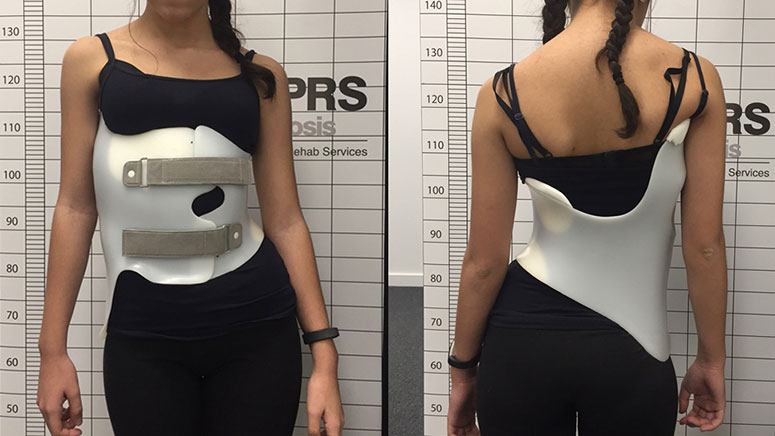
If the curves are less than 25 degrees, your orthopedist may recommend frequent monitoring to determine whether extra medical attention is necessary. Young patients with curves ranging from 25 to 45 degrees may be candidates for treatment with bracing. Although bracing does not correct the curve, experts believe it can help stop progression in about 75% of patients. Bracing is a success when progression stops and is maintained within 6 degrees of the original measurement of the curve.
Experts advise patients to wear a brace for 22 to 23 hours a day. The only time you’re expected to remove the braces is during sport activities or for hygiene purposes. In some cases, you may only need to wear the braces at night.
You can get any type of braces. The type of brace you use is usually dependent on the number of curves and where they are located. Some braces give support at the front, back, neck, and pelvis, while others give support throughout the underarms and torso.
Some braces may be rigid, while some are flexible. Flexible braces [3] are only used for patients with single curves. It is usually worn as a vest and it allows you to engage in sport activities.
Your doctor will advise you to continue wearing the braces until you stop growing and you’ve attained skeletal maturity. A weaning process [4] occurs, where the number of hours the brace is worn per day is gently reduced over a period of six months to a year. Within this period. The supportive muscles in your back and trunk will get stronger. Physical therapy may also help during weaning and bracing.