
First aid for Asthmatic Conditions
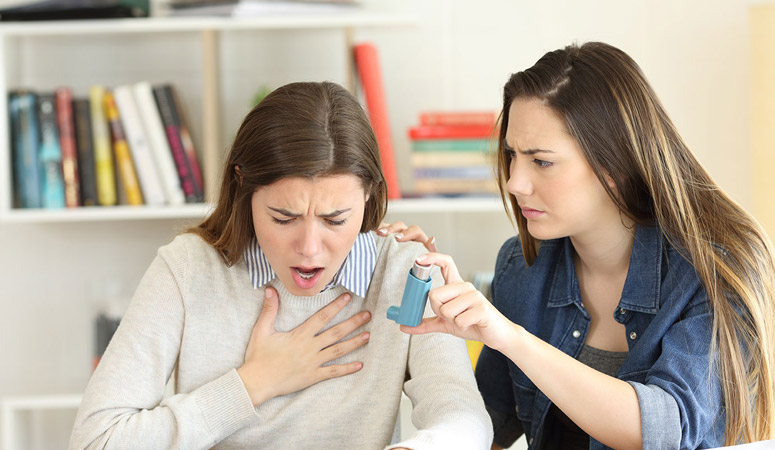
The global strategy for the treatment and prevention of bronchial asthma also implies taking measures to alleviate the patient’s condition during the period of attacks. So, it is necessary to calm the person down, give medications prescribed by the doctor (usually as an inhaler) and warm water, which should be drunk in small sips. It is necessary to convince the patient to wait in a calm state for the drugs to work, panic will complicate the situation. Do not force a person to lie down – allow them to stay in a sitting position [8], as asthma attacks are easier to tolerate and finish faster. If the measures taken do not alleviate the patient’s condition, it is necessary to immediately call an ambulance. Before the arrival of doctors, you should try to calm the patient down, while special attention should be paid to a child with an asthmatic attack. Immediately you need to call the ambulance team if a person has a critical condition: cyanosis of the skin and puffiness of the veins on the neck are observed, signs of clouding of consciousness appear, the patient suffocates, instinctively tries to expand his/her chest and take in air, jerks up his shoulders and chin. If the seizure persists and a life-threatening condition occurs, urgent hospitalization may be required. The asthmatic condition is relieved by intensive drug exposure, some patients may need oxygen masks and special medical equipment to make breathing easier.
In the event that an asthmatic attack has overtaken the patient when he/she is alone, and there is no one to provide assistance, one should remember the rules for stopping a dangerous condition on their own:
If symptoms appear that prevent an asthma attack (changes in breathing, wheezing, chest tightness), you must use an inhaler or take a medication prescribed by your doctor.
Next, you should try to calm down, sit down and take a comfortable position, close your eyes and breathe slowly.
It is necessary to alternately relax the muscles of the body, without holding your breath. You need to start with the face, then move to the arms and legs, then try to relax the whole body. It is necessary to try to stabilize breathing: do not swallow air with your mouth, inhale through closed lips so that a whistle is heard when exhaling.
To relieve the attack, you should bend forward, resting your feet on the floor, and your elbows on your knees, then inhale deeply and hold your breath for a couple of seconds, then cough up into a handkerchief to get rid of phlegm.
If, after the measures taken, the condition does not improve, it is necessary to call an ambulance.
References:
[1] https://www.webmd.com/asthma/asthma-medications
[2] https://www.webmd.com/drugs/2/drug-3591-783/theophylline/details
[3] https://www.webmd.com/asthma/guide/asthma-inhalers
[4] https://www.ncbi.nlm.nih.gov/books/NBK279518/
[5] https://www.ncbi.nlm.nih.gov/pmc/articles/PMC6435215/
[6] https://www.amazon.com/Eradicate-Asthma-Now-Water-Batmanghelidj/dp/1903571359
[7] https://www.healthline.com/health/severe-asthma/natural-remedies#ginger’
[8] https://www.betterhealth.vic.gov.au/health/conditionsandtreatments/asthma-emergency-first-aid#:~:text=To%20use%20asthma%20first%20aid%3A,each%20puff%20through%20the%20spacer.